
Last January 15, I had the extraordinary pleasure of having my PhD thesis examined by two academic giants across several disciplines: Claire Colomb (internal examiner, University of Cambridge Department of Land Economy) and Jun Borras (external examiner, Erasmus University Rotterdam). Now that the formal report is out, it’s beginning to dawn that the struggle of the last five years is finally coming to an end, give or take a few more weeks of minor corrections.
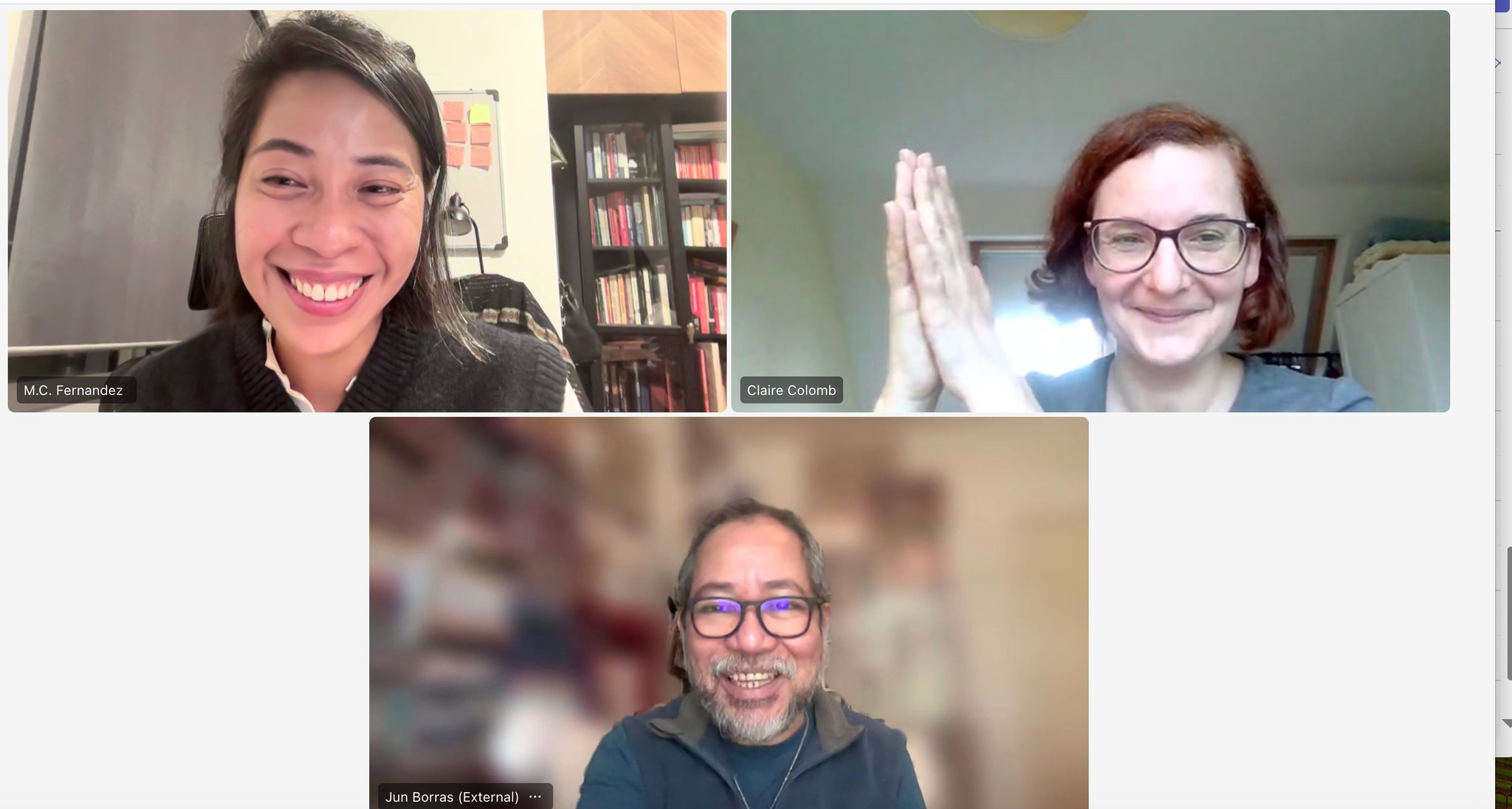
Feeling nothing but immense gratitude for I’ve worked and collaborated with. And of course, to Prof. Shailaja Fennell or taking a seed planted more than a decade ago and helping me see it through to the end. Eighty thousand words are frankly inadequate for something titled “Land Contestation in Peace Agreements: Evidence from Bangsamoro, Philippines” but all I hope is that this work, limited as it is, could help bridge the gap between what has been negotiated and the realities on the ground.
As per usual at these things, my PhD examiners asked what I would have done differently. My first answer was clear: to not have done this during a global pandemic. That said, I do not regret working on the ground all throughout, even if concretely, it meant doing the work three times—once for the PhD, once for the policy aspects, and at least once for the needs of the IDP respondents.
Methodological choices were informed by what Smith (2021:208) refers to as the indigenous research task of “coproducing indigenous knowledge with science and other Western disciplines”, even though for many indigenous networks, the words ‘research’, ‘consultation’ and even ‘coproduction’ itself have become ‘dirty’ due to common dynamics of extraction and co-optation. Research partnerships were thus deliberately designed given the range of issues at play. Core aspects of the project were jointly determined with key stakeholders in the Philippine central government and the MILF-led BARMM regional parliament, and displaced residents in the field sites of Lanao del Sur, Maguindanao del Norte, and Maguindanao del Sur.
So this is to begin thanking the many institutions I’ve learnt so much from, and perhaps pointing interested parties to some of the PhD’s policy outputs currently out in the wild:
1. My direct research and involvement in Marawi reconstruction predates the formal start of the PhD program in October 2020. I was originally accepted for Easter term 2020 but was automatically deferred to Michaelmas 2020-2021 due to the COVID-19 lockdown. Upon request of civil society actors and IDPs, the background material gathered for the Marawi case study was released in October 2021 as the first comprehensive stocktake of Marawi reconstruction efforts. It is in the public domain as Ilang Taong Bakwit ([How] Many Years Displaced), a policy report published by think-tank International Center for Innovation, Transformation and Excellence in Governance (INCITEGov) and Mëranaw civil society actors with support from Friedrich-Ebert-Stiftung. My gratitude goes to Ma’am Ging Deles and Ma’am Yasmin Busran-Lao for this and so much more, and to Prof. Tirmizy Abdullah for translating it into Meranaw.
Download (English): https://incitegov.org.ph/includes/publications/211015_Ilang%20Taong%20Bakwit%20(Final%20Draft)%20Pages.pdf
Download (Meranaw): https://incitegov.org.ph/includes/publications/FINAL_Ilang%20Taong%20Bakwit_Mranaw%20Version.pdf
2. Preliminary research on the land governance lawscape of the BARMM was facilitated by the Institute of Bangsamoro Studies through Prof. Abhoud Syed Lingga and Prof. Sarah Radam. On 10 May 2021, the Office of the Chief Minister released Memorandum No. 0246 series of 2021 facilitating data access for the project through IBS. IBS financed regional consultations and basic fieldwork through a grant funded by The Asia Foundation and USAID under the FORWARD Bangsamoro Project. A short policy brief was released in December 2021, with thanks to Sam Chittick, Cris Cayon, Rahib Nando, and Addie Unsi.
Download: https://drive.google.com/file/d/1YFfyK7FqlqBA6GQ5jAEydexS7ppLCwwM/view
3. Initial work in camps Omar and Badre was commissioned by the OPAPRU units involved in the Transitional Justice and Reconciliation Working Group, and later, the GPH-MILF Joint Task Force on Camps Transformation as early as December 2020. For direct work in Teduray-Lambangian areas, FPIC was given by the Indigenous Peoples Leaders Convergence Conference on 30 July 2021. My thanks goes to so many people: Jana Gallardo and Bambi Magdamo, MP Baintan Adil-Ampatuan, Timuay Alim Bandara, MP Froilyn Tenorio Mendoza to name a very few. The camps work is still live, but the some of the things I have been able to release pre-NDA are here: https://cids.up.edu.ph/wp-content/uploads/2025/10/Philippine-Strategic-Outlook-2024_Onwards-National-Security-and-Economic-Resilience.pdf
4. After a number of twist and turns, a research partnership was entered into with the Initiatives for International Dialogue to implement community-level mapping and analysis in the Marawi MAA and in Brgys. Kuya and Itaw in South Upi and Kabengi in Datu Saudi Ampatuan, Maguindanao del Sur. The field partners for Marawi were local NGO Kalimudan sa Ranao Foundation, Inc. and academics affiliated with a local university, Mindanao State University Marawi. In Maguindanao, engagement with stakeholders was done with United Youth for Peace and Development (or UNYPAD), Timuay Justice and Governance (TJG), and the Tëduray Lambangian Women’s Organization (TLWOI). This deserves a whole page: Gus Miclat, Louise Lampon, Jonah Samonte, Polly Gesulga, . Tirmizy Abdullah and Normindo Mosela , Amenodin ‘Ding’ Cali, Nurhabib Colangcag, Sittie Shairamae Amanoding, Omar Mohammad, Badruddin Mamendig, and Rejanna Camsa with Morsidin Husain, Norhana Amer, Fatima Cali, Rohainie Bunsa, Naspia Rigayo, Najerah Pangandaman, Janinah Hadji Marjhan, Layliah Ayonan, Rojohn Ented, Chona Manuel, Jordan Saliling, Lhen Mateo, Wilfredo Dizon, Jr, Mikko Tamura, and Kathleen Loresca.
Download: https://iidnet.org/wp-content/uploads/2023/03/IID-Land-Research-updated.pdf
Note: since had to exise the chapter on the padian from my final manuscript, my and Prof Abdullah’s initial piece has been published in a volume edited by Dr. Nikki Gregorio on visual culture in the Philippines: https://link.springer.com/chapter/10.1007/978-3-031-90421-9_2
5. The final research agreement was with the BARMM’s Ministry of Agriculture, Fisheries, and Agrarian Reform (MAFAR) under its then-Minister, Mohd. Shuaib Yacob and through the tireless work of CARPO Jarra Radjid. I am still optimistic that that review of CARP in BARMM will still see the light of day. 🙂 My thanks therefore goes to the hardworking middle managers and frontliners of BARMM: , CARPO Rhocs Mindalano, CARPO Amier Caludtiag, CARPO Said Tingkahan, CARPO Jibreel Ladiasan, CARPO Jimson Jalilul, SUARPO Sierra Lidasan, as well as their counterparts in other agencies such as MHSD (particularly the late Minister Uz. Hamid Barra and Abdulhamid Alawi).
I suspect that the final manuscript will end up being embargoed (until it sees the light of day hopefully as a book someday), but in the meantime, let me know if anyone wants to talk shop further. 🙂
 Notes from the Field