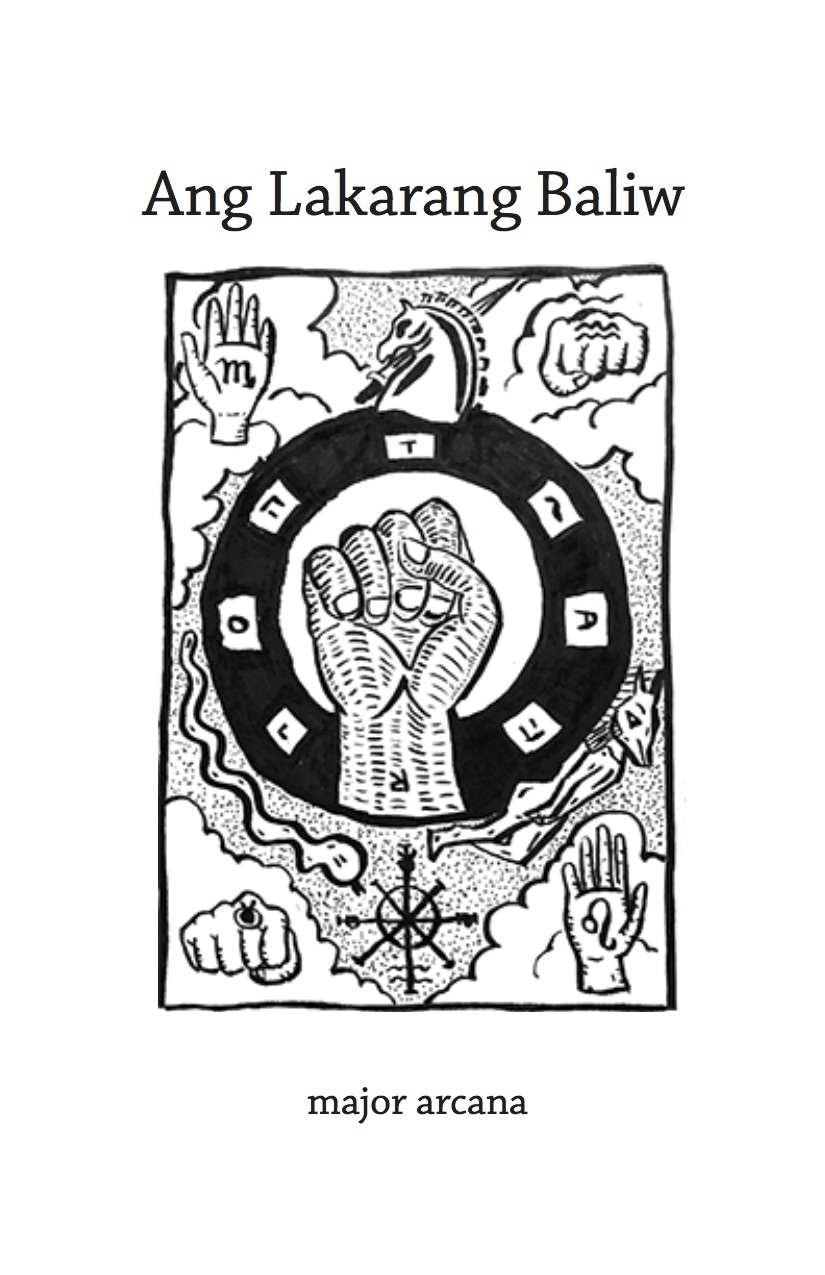
The Fool’s Journey

When depressed about the state of the world, what better way to procrastinate but through (f)art.

I challenged myself a few months ago to try to draw one thing a day for a year. Mostly for fun, and partly to recover from the creative crippling that brought me out of the humanities and into development work over a decade ago.

Being the obsessive I am, I decided to use seventy-eight of those 365 days to draw my own tarot deck. Drew the 22 cards of the major arcana, one card a day, each card corresponding eerily to each day of one of the most intense months I’ve had in a while. While some of them were partially painted, I’ve kept the black-and-white feel as a nod to two of my favorite decks: Kim Krans’s The Wild Unknown, and the David Foster Case and Jessie Burns Parke Builders of the Adytum deck.

I figure the best way to motivate myself to get through the next 56 images is by compiling them into a zine, since that’s what kids like to do these days. I figure I’ll eventually print them into a proper deck, but in the meantime, if anyone’s reading this, feel free to message if you’d like a physical copy of the twenty-two cards of the Fool’s Journey, or in Tagalog, ang lakarang baliw. Otherwise, I’m putting a low-resolution version online here: (Ang Lakarang Baliw).

I realize belatedly that it’s a little fuzzy, since the images weren’t scanned (I don’t own a scanner) and were just captured on an iPhone 6. It’s the first thing I’ve made and finished purely on my own just for kicks since high school, so do be kind.


Implementing Peace and Development in the Bangsamoro: Potentials and Constraints of Socio-Economic Programs for Conflict-Affected Areas in Southern Philippines (1913-2015)

Even as an early-career institution-less wannabe scholar and development worker, I’ve always tried to walk the fine line between theory and practice, research and ground operations. I’ve given up on getting my shit proper journal peer-reviewed so in case anyone has any interest in reading a very roughly written attempt at a history of government development programs for ARMM from 1913-2016, focusing particularly on the mainland (Maguindanao, with spillovers in Ranao)–here you go.

Download a pdf here: Fernandez – P&D in the Bangsamoro 2017-06-20

Main point being to look at potentials and constraints, especially (!) on the sins committed. A key limitation: it looks purely on government policies and interventions, and not on international donor interventions. This is partly true due to data constraints, but also because local decisions and choices will largely determine if any true transformation can arise. And I say this as someone who has served in government but whose bills have been paid for the past few years by the multilaterals.

Continue reading “Implementing Peace and Development in the Bangsamoro: Potentials and Constraints of Socio-Economic Programs for Conflict-Affected Areas in Southern Philippines (1913-2015)”

Conflict in Cities and the Contested Philippine State: Notes After Marawi

Originally a FB post but migrated here because the maps and photos wouldn’t show.

Dahil ako’y taga Maynila lamang, hanggang mabilisang sulat lang ako. Para sa minamahal na mga kaibigan at katrabahong Meranaw, kung mamarapatin.

It has been over a week since the May 23 Maute Group attack on the Islamic City of Marawi, and President Rodrigo Roa Duterte’s declaration of Martial Law in Mindanao. Skirmishes to clear and control the city are still ongoing. The majority of its 201,785 recorded citizens have since fled on foot, leaving behind combatants, journalists, and the occasional terrified resident trapped in the crossfire or attempting to protect their homes and businesses from looting.

Many questions remain. Was it truly a botched military operation against Abu Sayyaf Group leader Isnilon Hapilon, who had purportedly ventured out of Basilan to operate in the mainland, unifying the disaffected under the black flag? Or was it well planned in advance, this scene of least fifty young fighters emerging from Lake Lanao, occupying and damaging key installations—hospitals, churches, university buildings, city hall, the local jail? Was the Chief of Police truly beheaded (despite photos emerging of him appearing alive and with head intact)? Can we call them ISIS or IS-Ranao? Why is Marawi City being shelled? How will the airstrikes affect power dynamics on the ground? Will the declaration of Martial Law in Mindanao set the stage for nationwide policy?

What is established is that as of May 31, at least 22 civilians, 30 security personnel and sixty-odd Maute and ASG fighters have been killed. Over 44,000 families have been recorded as displaced across Northern Mindanao, taking uncertain shelter during the Holy Month of Ramadan in evacuation centres and the homes of friends and relatives. Only twenty percent of the metropolitan area has power restored; food in surrounding communities is scarce. Tensions have spilt over to neighbouring towns. It will take weeks before comprehensive damage assessments can be conducted but one wonders if Marawi, with its rich 400-year-old history and its role as the economic, political, and cultural heart of Lanao del Sur, can fully recover.

Mainstream approaches to Mindanao’s peace and conflict situation is through its security or political dimensions, and for the immediate phase, the humanitarian response for the likas (“those who left”, a more culturally-appropriate alternative to bakwit), or internally displaced persons. However, Marawi, and to some extent its predecessor Zamboanga, begs the question: how can we start thinking about peace in terms of how conflict dynamics play out in actual space and place, in the fabric of our communities and cities? Violent state-non state contestation in the Philippines has been largely rural, with a few sporadic exceptions. So does Marawi signal a contemporary turn to urban warfare, similar to many of our Western counterparts? Is urban conflict the next Philippine battleground?

marawi1.jpg

Continue reading “Conflict in Cities and the Contested Philippine State: Notes After Marawi”