
An updated version of my usual planning and peacebuilding rant was published as a chapter of Vibal’s latest, alongside a very distinguished array of thinkers and doers.
I may not have been born on this island but somehow most of this adult life has been spent living in/on it, working with its peoples, thinking about its beauties and frailties and strengths. And since somehow there seems to be a persistent perception that culture has no relevance in spatial planning, will share this bit again despite some process controversies. 🙂
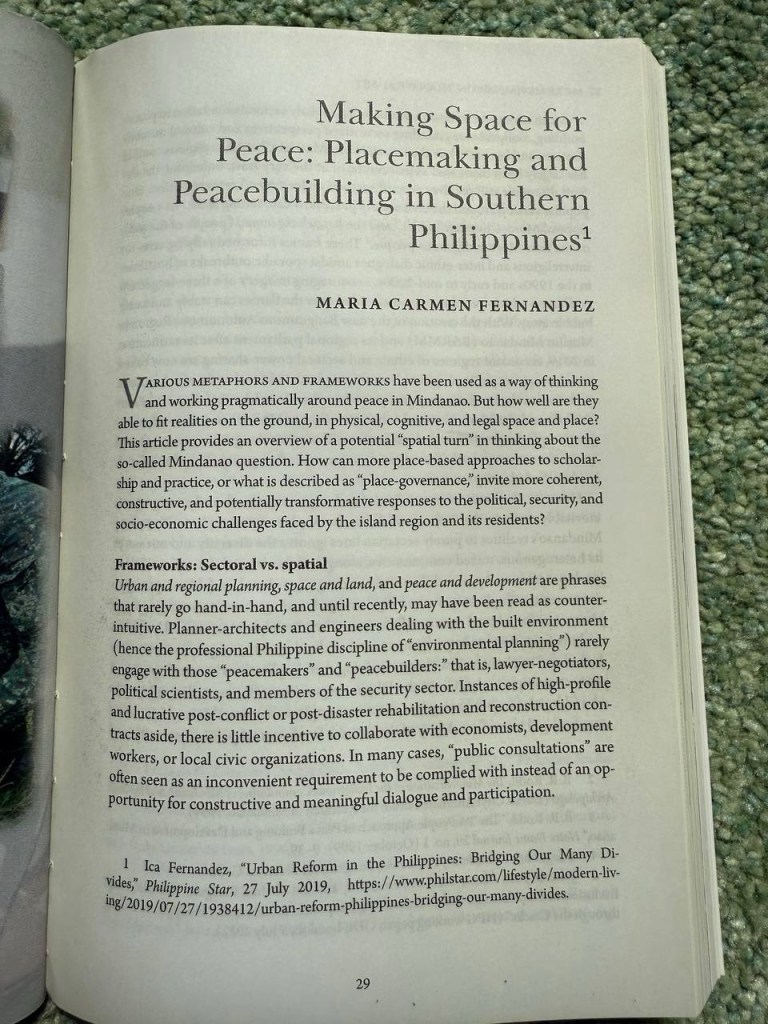

Making space for peace:
place-making and peace-building in Southern Philippines
Maria Carmen (Ica) Fernandez
Various metaphors and frameworks have been used as a way of thinking and working pragmatically around peace in Mindanao—but how well are they able to fit realities on the ground, in physical, cognitive, and legal space and place? This chapter provides an overview of a potential ‘spatial turn’ in thinking about the so-called Mindanao question. How can more place-based approaches to scholarship and practice, or what is described as ‘place-governance’, invite more coherent, constructive, and potentially transformative responses to the political, security, and socio-economic challenges faced by the island-region and its residents?
Frameworks: sectoral vs spatial
‘Urban and regional planning’, ‘space and land’, and ‘peace and development’ are phrases that rarely go hand-in-hand, and until recently, may have been read as counterintuitive. Planner-architects and engineers dealing with the built environment (hence the professional Philippine discipline of ‘environmental planning’) rarely engage with those tagged as ‘peacemakers’ and ‘peacebuilders’: that is, lawyer-negotiators, political scientists, and members of the security sector. Instances of high-profile and lucrative post-conflict or post-disaster rehabilitation and reconstruction contracts aside, there is little incentive to collaborate with economists, development workers, or local civic organizations. In many cases, ‘public consultations’ are often seen as an inconvenient requirement to be complied with instead of an opportunity for constructive and meaningful dialogue and participation.
Much of these attitudes are driven by a popularly sectoral orientation to peacebuilding, alongside longstanding securitised perspectives and cultural misconceptions and biases. While the narrative of Muslim-Christian religious conflict has largely been dismissed as inaccurate, or at the very least, unhelpful, the default discourse still revolves around sectoral inclusion and representation. One popular version around the civil society peace advocate set is the ‘tri-people’ trope of Moro, Christian ‘settler’, and the katawhang lumad (“people of the soil”), or the non-Moro indigenous peoples. These frames informed rallying cries for interreligious and inter-ethnic dialogues amidst sporadic outbreaks of hostilities in the ‘90s and early to mid 2000’s, encouraging imagery of a three-legged tripod upon which a cooking pot suspended over the flames can stably and safely bubble away. With the creation of the new Bangsamoro Autonomous Region in Muslim Mindanao (BARMM) and its regional parliament after its popular ratification in 2019, accordant regimes of ethnic and sectoral power-sharing are now baked into the region’s political system, combining both informal and unspoken deals cut between the revolutionary groups such as the Moro Islamic Liberation Front (MILF) and the Moro National Liberation Front (MNLF) and their ethnolinguistic and island-vs-mainland factions. This exists alongside more structured quotas for women, youth, the religious sector, and other groups linked to officially-identified identity markers.
However, the limits of sectorally-defined, representation-based arrangements inevitably come to the fore, especially in the implementation phase. To reduce Mindanao’s realities to purely sectarian lines ignores the diversity and nuance of its heterogenous, mixed communities, along with horizontal dynamics of class, kinship, access, and power differentials across geographies. Such blind spots give rise to serious implications when legal and political agreements—ranging from parameters for internal revenue allotments, to territorial delineation and inclusion, to shifts from unitary to parliamentary or federal systems of government–are drafted and implemented without clarifying their implications in actual space and place, at multiple scales. Given the Filipino reputation of being stellar policymakers and legislators but having less success at implementation, this is a bitter but necessary pill to swallow. Many of the nation’s fundamental political, security, and development challenges are embedded in our streets and buildings, in the fabric of our communities in both urban and rural settings. In the same light, even the most beautifully-rendered architectural designs and area development plans cannot be implemented unless checked for location-specific political, cultural, and financial issues, and the necessary safeguards built in to address them. So, how then can we begin to parse the possibilities and constraints of Mindanao vis-à-vis the rest of the Philippine archipelago, across the arbitrary urban-rural divide, and at neighbourhood scale?
Mindanao vis-a-vis the Philippine archipelago
As one of the country’s three major island groupings, Mindanao provides an entry-point to the broader story of the Philippine archipelago. Although recent scholarly interest in archipelagic Southeast Asia has increased because of geopolitical and maritime security concerns, a spatial view equally sheds light on internal contestations, where ‘archipelagic-ness’ hearkens to how bodies of water and geographic features facilitate both connection and division. Tolentino (1999) drawing from Benitez-Rojo (1992) expands this physical definition into the sociocultural, critically locating the regional politics of island Southeast Asia in terms of the tension between parochial insularity and transnationalism, as well as constructed national unity and uneven development regimes. While the shared experience of colonialism and imperialism galvanizes these islands into legal identities, these artificial unities clash with the diversity and hybrid fluidity experienced at human scale.
Seeing Mindanao from the archipelagic lens exposes national discourses and logics of extraction and erasure. We see this in the liminal space that Mindanao occupies in the minds of non-Mindanawon Filipinos: forgotten when convenient, strange and distant on an average day, but almost always fraught with perceived and imagined dangers. Mindanao’s 27 million registered inhabitants comprise roughly 24% of the Philippine population as of 2021. Despite technical issues around regional cadastres, it generally covers two-fifths of the country’s total land area and one-third of Philippine territorial waters, including 30 out of 124 declared key biodiversity areas. Its six administrative regions—Northern Mindanao, Caraga, Davao, Zamboanga Peninsula, SOCCSKARGEN (formerly referred to as Central Mindanao), and the Bangsamoro Autonomous Region in Muslim Mindanao (BARMM)—reflects the range of experiences and relationships. Most of the Philippines’ 70-odd indigenous languages are spoken across the island-region. Although the most recent census places the religious mix of the population as 70% Christian and 24% Muslim, Spanish proselytising never had a true foothold in inland Mindanao. Various studies of the extent of churches and parishes at the end of the century show that their access was limited to strategic garrisons along coastlines, with the Americans having slightly better luck through a mix of instruments albeit with mixed success. Thus, its experiences have a distinct tenor compared to Luzon and Visayas, although the BARMM often draws comparisons to the other unconquered subnational region given autonomous status in the 1987 Philippine Constitution, the northern Cordillera in Luzon.
Historians and revolutionaries alike cite the forcible annexation of Mindanao to the Philippines via the 1898 Treaty of Paris as one of the historical bases for the conflict. However, the poor quality of social science education in the Philippines means that this is largely unknown to the public, and therefore Mindanao is at once both artificial tabula rasa and ‘land of promise’. With our maps oriented just so, Mindanao is forever the peripheral backwater except when the de facto front-door (as opposed to smuggling backdoor) to the rest of maritime Southeast Asia becomes useful for regional trade partnership agreements such as BIMP-EAGA. At worst, Mindanao is often claimed in jingoistic terms by those from Luzon and Visayas as something that is “ours”, whether in relation to the Sabah claim, or the various threads of ideology-based armed conflicts with bloodied histories across the island—often by Filipinos who will, more likely than not, never set foot on Mindanao’s soil. At least one sitting national lawmaker has tearfully relayed stories of his fellow congresspersons assuming that Muslim Mindanawons are not indigenous to Mindanao but are instead migrants from Malaysia or Indonesia, and worse, have animal tails under their pants (a common dehumanising rumour used against the archipelago’s indigenous).
Until recently, ARMM and now BARMM socioeconomic statistics were reported separately from those of national indicators, as they were seen to negatively skew the national average. Prior to the height of the wars in the 1960’s, however, Mindanao was economically at par with Luzon, and three times more affluent than the Visayas region. A key indicator is the fate of Jolo. As the seat of the Sultanate of Sulu, Jolo was a burgeoning hub prior to its being razed to the ground during the wars between the Philippine Constabulary and the Moro National Liberation Front (MNLF) and was never truly reconstructed. This feeds into the narrative of conflict-affected Mindanao, but armed contestation is a reality for the entire Philippine archipelago. During the period of 1986-2004, 91 percent of the country’s provinces were affected by ideology-based armed conflict, all of which have roots in historical grievances and narratives of dispossession. However, three of the five non-state armed groups with formal peace deals with the Philippine government are in Mindanao, which has seen the fiercest fighting, and the very real intergenerational consequences thereof.
While Luzon generally generated roughly 55% of all economic growth, the historically poorest regions of CARAGA and the new Bangsamoro Autonomous Region in Muslim Mindanao (BARMM) host the largest armed groups in the archipelago: the Communist Party of the Philippines / New People’s Army / National Democratic Front (popularly known as the NPA), and the Moro Islamic Liberation Front (MILF) and its precursor, the Moro National Liberation Front (MNLF). The MNLF and MILF have signed peace agreements for the transformation of governance in southern Philippines but the talks with the NPA remain incomplete despite renewed hopes. The same resource-rich yet income-poor areas are home to many indigenous peoples’ groups, who tend to be caught in the crossfire. The protracted, low-intensity and seemingly intractable nature of these localized and multiple conflicts means that social tensions are never fully resolved, often spills into what is called horizontal conflicts related to political competition and the so-called ‘shadow economy’, and so has become a barrier to achieving full socio-economic potential. The recent positive economic performance of the BARMM after the peace deal and its establishment of a regional parliament is a hard-won success story. However, this must be sustained beyond one or two administrations. Estimates show that civil wars cost a medium-sized developing country the equivalent of 30 years of GDP growth, and will take at least a generation to reverse. No country with a running subnational conflict such as that experienced in the Philippines for the last six decades has achieved a Sustainable Development Goal.
The links between conflict and underdevelopment have deep historical and political roots. Taken from a regional frame, ethno-nationalist conflicts in Southeast Asia are traced to the expansion of central authorities in the late 19th and 20th centuries, as well as the rapid decolonization processes after the 1940s and 1950s, when governments sought to rapidly integrate minority populations into freshly-minted states. These asymmetries are further highlighted by the rise of ’imperial cities’, or political, ideological, and commercial capitals that dominate surrounding regions (Driver and Gilbert 2003) or ‘internal colonies’ (Howe 2002). Even the man hailed as the first Mindanawon president raised on a wave of populist sentiment against ‘Imperial Manila’, former Davao mayor Rodrigo Roa Duterte, has settler-colonial roots. Born in Leyte, Duterte’s father hails from an influential clan from the Visayas, although he claims at least one grandfather of Maranao descent. And although secessionism no longer a publicly-declared objective of the MNLF or MILF, Duterte’s post-presidency ‘jokes’ in 2024 have shown that it can be pulled out as a threat whenever deemed politically necessary. Even as former revolutionaries of different stripes now proudly wear the presidential seal on their jackets even as they had previously declined to face the Philippine flag or sing the national anthem in previous lives. This speaks to the strange relationship between Mindanao and Manila’s power centers, where so much of Philippine power is concentrated in and driven by the capital, with varying degrees of devolution to local vassals. In the case of the former ARMM to current BARMM, no regional governor has ever been elected without the by-your-leave of Malacañang—as a convenient vote bank, events such as the Maguindanao Massacre—infamous for being the world’s largest single killing of journalists in one fell swoop—are par for the course. Another Mindanawon cynical adage is that when something happens in Manila, one of the options in the national political playbook is to make something explode in Mindanao. All these tensions and contradictions complicate the question of transitional justice, or how the Philippines as a whole can deal with Mindanao’s past in the present day—and by doing so, ensure that the island is not just a phantom appendage, but a healthy part of the national body politic.
Mindanao, the land question, and the artificial urban-rural divide
The archipelagic lens to peace-making and peacebuilding exposes the artificial urban and rural divide in our minds. Part of the problem lies in the misconception that the need for ‘peace–building’ is a niche issue that affects only people in the hinterlands. In many ways, Mindanao was and still is treated as an agricultural ‘settlement frontier’ and ‘extractive frontier’. These neat categories of ‘agrarian’ vs ‘urban’, ‘rural’ and ‘city’ belie the continuum of landscapes that underpin Mindanao’s horizontal and vertical dynamics—much of which is tied to the question of land.
Land is acknowledged as one of the major drivers of armed conflict with Mindanao-specific studies arguing that the conflicts on the island have agrarian roots (Vellema, Borras, Lara, 2011). Thus, it is no surprise that land provisions are part of the major peace deals. The unfinished Comprehensive Agreement on Socio-Economic Reforms (CASER), being negotiated with the Left has extensive components on agrarian reform and rural development, national industrialization, and the protection of the environment, including rehabilitation and compensation for affected areas. Similarly, marginalisation through land dispossession is duly acknowledged by the 2014 Comprehensive Agreement on the Bangsamoro (CAB) and the Bangsamoro Organic Law (BOL). However, the Philippines has no unified land governance framework, and the most resource-rich areas tend to have multiple tenurial overlaps, including those considered to be indigenous ancestral domain.
Another stumbling block to addressing land governance issues in Mindanao is the tension between customary and legal perspectives regarding land ownership and use, particularly in the Bangsamoro. Multiple land and social justice instruments have been legislated in the Philippines, but its flagship program on agrarian reform, for example, is seen to not be fit for purpose in Muslim Mindanao as it is ahistorical and may even perpetuate historical injustice by not acknowledging prior claims. Gutierrez and Borras (2004) note that ‘‘the more land that is redistributed according to the narrow limits of CARP, the harder it will be to settle the historical cases of dispossession.” The impact of land tenure insecurity is palpably seen among those who take up arms. As it is, roughly eight out of ten of Mindanao’s farmers and fisherfolk categorised as poor or near-poor. Out of a 2015 survey of the MILF’s Bangsamoro Islamic Armed Fighters (BIAF) and the Bangsamoro Islamic Women’s Auxilliary Brigade (BIWAB), three-quarters (74%) of combatant households reported that they were engaged in agriculture, 56 percent of whom said they owned farmlands, compared to 65 percent of households across the rest of Mindanao, and 59 percent of households across the rest of the country. Among BIAF households engaged in agriculture, only 34 percent say that they hold land titles, and of those only 61 percent of their land is titled. Thus, only one-quarter of farming families have some titles (34% of 74% engaged in agriculture), and for those lucky enough to have some titles, they only cover, on average, two- thirds of their lands. At the same time, post-BARMM plebiscite consultations indicate the need for more culturally-appropriate forms of land governance and redistribution in the BARMM. Thus, while ‘culture’ is a loaded term, potential flashpoints include differing concepts of land ownership and use; social norms of feudal relationships perpetuated by the sultan/datu class; and fuzzy assumptions and expectations related to post-agreement combatant packages, community peace dividends, and the protection of internally-displaced populations.
Although these contestations have traditionally been rural in nature, increasing urbanization is making a place-centered approach to peace–building, or a conflict- sensitive approach to place–making, a more urgent issue. At present, half of all Filipinos live in cities. This is projected to reach 84% by 2050. Philippine cities generate 70% of the GDP, of which 36% is generated in Metro Manila alone. As written by Mumford in 1938, cities are the ‘point of maximum concentration for the power and culture of a community,’ and that one of the chief functions of the city is to ‘convert power into form.’ Part of this is acknowledging that the state of our cities, its design and infrastructure is but a reflection of social realities. Cities are conflictual by their very nature, but the density of people, infrastructure, goods, and services that characterises urban life ensures that the scale of urban violence and insecurity can easily eclipse that of open warfare, with high human and economic costs. This has implications not only on places such as Marawi, Cotabato, or Jolo, but even in areas such as Metro Manila, which in 2017 was the ranked the 10th most stressful city in the world, and the only one on the list without a traditional civil war. Although urban poverty incidence (12.5%) was less than half of the national poverty incidence (25.2%) in 2012, cities remain sites of deep and multidimensional poverty, where crushing traffic jams occur just outside closed-off subdivisions and gated communities sitting cheek-by–jowl against sprawling slums.
One manifestation is the divide between residential subdivisions and informal settlements, the latter being a product of both poverty and widespread displacement particularly in Mindanao’s conflict-affected provinces. An uncompleted assessment undertaken by the Cotabato City Government in 2008 estimates 7,000 internally displaced households (Minland 2009), numbers which are likely to have swelled with successive waves of displacement. However, local development plans barely mention these issues except for the general housing backlog. National and regional programs focus on either the immediate post-disaster response in transitional camps or the provision of housing (‘core shelters’) but IDPs who choose to stay with relatives in urban slums are virtually invisible to both national and local government. As a result, many of these IDPs eke out a living in the informal economy, as trisikad (pedal powered tricycles) and banca operators, food sellers, or as providers of micro services as construction workers, laundry women and day laborers. In general, these services are limited to their communities of residence, and it is rare that IDPs can continue to earn a living using skills practiced in their place of origin (Minland 2009). Elsewhere in the Philippines, many public officials use urban poor communities as vote-banks (Porio et al 2004), although the link between IDPs and vote banking in Cotabato and elsewhere in Mindanao has yet to be studied.
Against maladaptation: Peace at neighbourhood scale
Ultimately, these placemaking and peacebuilding issues must be addressed at neighbourhood scale: at the level of a barangay or sitio’s paths, nodes, edges, districts, landmarks—plot by plot, claim by claim. In this light, armed conflicts—which translates in Tagalog as ‘hidwaan’, or separation—are just more dramatic reflections of the kind of disconnections we deal with on a day-to-day basis, or why our current systems of transportation, education, housing, health, livelihood, and culture do not seem to reflect our most fundamental needs and realities.
Mindanao’s emblematic place-making-as-peace-building challenge of the last decade is the 250–hectares of destroyed urban core in the Islamic City of Marawi, and the fundamental request of residents to allow them to return to their homes. Destroyed in the five months of fighting that began in May 2017 between government troops and Meranaw ‘black flag’, ISIS-inspired actors such as Dawlah Islamiyah (popularly known as the Maute Group), the Sulu-led Abu Sayyaf Group, and aligned foreign fighters, the city escaped most of the wars of the 1960s to the 2000s only to experience the first large-scale urban conflict since the 1970’s. This marked a turn in the longstanding Mindanao conflict, which has been mostly rural in nature. The Marawi crisis displaced almost 300,000 people (UNHCR, 2017), including IDPs who were later battered in December 2017 by Tropical Storm (TS) Tembin, known locally as Vinta, producing conditions of double displacement (Fernandez, 2019). Although a Compensation Bill was passed in 2022, it highly unlikely that this legislation will be enough to finance, let alone ensure, residents’ dignified return. The government’s reconstruction itself ensures that at least half of the inner core’s original pre-Siege residents will be permanently displaced. However, Marawi occurred barely four years after the 2013 Zamboanga Siege, where three weeks of fighting between security forces and Misuari-affiliated Moro National Liberation Front members resulted in the total destruction of five barangays in the city with hundreds of MNLF, civilians and security forces dead and no less than 120,000 families displaced. Restrictive policies such as ‘no title, no return’ have rendered families homeless, staying in transitional shelters even after a decade.
In situations of violence and contestation, maladaptive policies often visibly manifest in what Pullan (2011, 2013) refers to as conflict infrastructure, or the physical features of conflicts such as security walls, buffer zones, checkpoints, and mobility regimes that damage urban fabric to a degree that “what should connect and benefit from contact does not.” In Northern Ireland, visible conflict infrastructure is termed ‘interfaces’ and ‘contested space’ and are used to illustrate strains due to access to public space in segregated rural or peri-urban areas despite not having physical barriers to buttress such divisions (Bell et.al 2010). The latter is closer to the Philippine context, as contestation manifests in non-tangible ways in both urban and rural space (Fernandez, 2016). The continued application of maladaptive policies leads to an intergenerational feedback loop, with heavy spatial concentration of poverty and segregation in deprived areas (Wacquant, 2008), vis-a-vis gentrified ‘safe spaces’.
In the case of peri-urban cities in Mindanao such as Cotabato and Marawi, for example, where vertical violence is mostly latent and horizontal violence is ever-present, contested space manifests through checkpoints, security guards and implicit curfews, but heavily through socio-spatial segregation and overlapping uses and meanings of various sites. A typical roadside military or police checkpoint sign written in Tagalog and other vernacular languages will say, “We apologize for the delay. We are doing this to ensure the safety of our community from terrorism.” These checkpoints are often located along bridges and major thoroughfares and the national highway. While their locations can shift or their numbers increase depending on the perceived security need (as in during election season), these barriers are so ubiquitous that they are used as advertising. However, the most marked form of division shows up in the form of socio-spatial segregation. While most Mindanawon cities pride themselves for multiculturalism and ethnic diversity, a key issue is the segregation of neighborhoods, where a locality can be ethnically diverse but at the micro neighborhood/village level, they are ethnically segregated. Until recently, there were unspoken norms of avoiding certain areas after dark, or not congregating heavily in public spaces lest a grenade be lobbed into crowds. Intermittent incidents of small bombs planted around hotels and shops or near cars parked by the roadside are not uncommon. Only a fraction of Mindanao’s land use is formally marked for public space. For those that do exist, very few are not silent about the overlapping uses and contested histories. In the absence of substantial ‘shared’ spaces, the markets of the city are a good indicator of a class divide. One example is the so-called Nicaragdao, or Agdao Market, the site of bloodiest days of the CPP/NPA/NDF conflict in Davao, which in turn was referred to by mid-1980s media as ‘Murder City’ long before the events involving the Duterte-era Davao Death Squad. As with other sites of violence, these places provide sharp contrast to the more upscale malls and commercial complexes that are able to flourish under (limited) affluence.
All these issues are further exacerbated by the climate question. Until recently, Mindanao was supposedly below the typhoon belt and Central Mindanao considered shielded by Mt. Apo. This is no longer the case with increasing extreme climate events. Even without the shift in weather patterns, the Philippines has historically been one of most risk-prone countries in the world, and in 2023 was considered to be most disaster-prone country in the world followed by Indonesia and India. From 2010 to 2021, the Philippines ranked first in terms of internal displacement in Southeast Asia, and in 2018, it ranked second globally in terms of internal displacement—80 percent due to natural disasters, and 20 percent due to armed conflict. Philippine law defines complex emergencies as “a form of human-induced emergency in which the cause of the emergency as well as the assistance to the afflicted is complicated by intense level of political considerations”—thus, armed conflict is considered a human-induced complex emergency, which combined with environmental shocks creates further layers of complexity, at street and neighborhood scale.
Placemaking and peacebuilding: bridging our many divides
At its core, the toolkit for place-making for peace-building is driven by two things: ensuring connections, not divisions, and “dealing with the past”, or the things that make people hurt and angry—in tangible form. It also hearkens back in many ways to the model of peace-building as a spiritual and ethical act, particularly to the root work of religion, re-ligiere, which means reconnection. It is not about dogma or right or wrong, but bringing together what has been severed. While planning at its best can and should be a tool for inclusive economic growth and redistributive justice, it is often complicit in the power structures that propagate inequalities themselves. Thus, for the Philippines to reach its full potential, there is a need for area development that focuses not only on legalities, economic investment, or physical infrastructure, but also includes a full a range of targeted, human-scale processes and designs that can bridge relationships between and amongst people who live, work, and play in the most vulnerable communities.
What can be done to connect and not divide? Much of the established conflict economics toolkits are at the national, regional, and provincial levels (which are crucial for strategic planning), but the nuances of these areas can be best understood and therefore implemented at the level of the city and the architectural shape of neighborhoods, in the praxis of what people in cities do. This means combining the toolkits of both peace–building and urban design to encourage healthy spaces and linkages between economically lagging and leading areas. This means national policies that allow for regional and provincial and local integration, while dealing with the specific challenges of each place.
The unfinished talks with the CPP/NPA/NDFP should have led to the drafting of the so-called CASER, which includes substantive provisions on agrarian reform, ancestral land, environmental protection, and industrialization. The GPH-MILF Comprehensive Agreement on the Bangsamoro acknowledges the historical marginalization and land dispossession of the non-Christianized peoples of the region and guarantees the area development of six major camps of the MILF, as well as the potential provision of programs such as housing for demobilized former combatants. Again, these issues cannot be seen from just a counterinsurgent or physical infrastructure lens—we forget at our peril that these mujahideen and mujahidat did not fight for handouts or raw concrete, but something much more dignified. to finish clearing bombs and unexploded ordinance to allow them to finally go home.
For people working as urban planners, engineers, or architects, this means shifting from the dominant Philippine misconception of spatial planning as a purely technocratic or physical design exercise but something larger than the sum of its parts. A useful guide phrase is ‘conflict-sensitivity’, which is operationally defined as a contextual understanding of the conflict topography unique to a given area that should inform programs and project interventions. It is a term typically used in tandem with the principle of ‘do no harm’, meaning that development decisions should not cause further damage to a community or a society that has been ravaged by conflict. This highlights that there are no ‘one-size-fits-all’ solutions, and so interventions must be nuanced based on the specific drivers and challenges in the area. A peace–building approach to place-making means that development is not just delivering hard infrastructure, but designing processes that can build confidence and stability . Although often contentious, peacebuilding metrics are also often framed as ‘building social cohesion’, which loosely refers to the horizontal relationships that bind communities together, as well as the vertical relationships between communal groups and the state. This is important in the implementation of peace agreements, which have major components related to land, housing, and property. It is equally important when dealing with informal settler families and small-scale vendors in cities, who traditional development paradigms dismiss as eyesores although global evidence now acknowledges the major role of the so-called informal economy in driving the engines of growth.
To ensure conflict-sensitivity, however, also means that engineering practices should not be applied in a blanket, maladaptive fashion to conflict-vulnerable areas. Maladaptation is most popularly defined in terms of any changes in ’natural or human systems that inadvertently increase vulnerability to climate stimuli; an adaptation that does not succeed in reducing vulnerability but increasing it instead’ (IPCC, 2001). Maladaptation can be experienced spatially (in terms of ill-suited design and construction), politically (through unresponsive, command-and-control approaches to governance and management), and discursively (Coafee and Clarke, 2015). Elsewhere, colleagues and I have argued that post-crisis response in the Philippines is characterized by an approach to spatial governance that excludes, alienates, and erases people from decision-making processes in ways that can be described as punitive. Inherited planning and policy instruments are used to erase the poor and marginalised from services, spaces, and even their fundamental rights to life, a triple-marginalization that reinforces existing socio-spatial inequalities. This is summarized as gunpowder and cement urbanism—what we refer to in the vernacular as ‘utak pulbura, utak semento’–a belief that complex emergencies can be solved by megaprojects, urban warfare, or putting the poor in the grave. The weaponization of law (in relation to land expropriation, reclaimed areas, disaster-risk reduction [DRRM]-related no-build zones, and the privileging of awarded land titles regardless of provenance over customary claims and transactions) will need to be reconciled with the Constitutional commitment of social justice and explicit peace agreement commitments on ‘normalization’ and transitional and restorative justice.
This asks for a multi-dimensional, multi-sectoral framework, not sectoral silos, which will then be grounded in space and place. An approach with a place-governance lens demands a balance between both short-term confidence-building requirements and long–term broad developmental outcomes, which cannot be limited by traditional three-year political terms. Similarly, this means that culture and identity is not just a question of aesthetic design, but asks how people use places and spaces to live, work, and play. This also means gradually building a homegrown conception of Philippine archipelagic urban politics, given that the planning concepts and land ownership laws presently in use and taught in schools are legacies of our Spanish and American colonial pasts. As shown in our car-centric transport system, these foreign models are often stacked towards the middle-class and upper-middle class. The Philippines has no national urban or general land use policy or plan, and is hampered by fractured institutional authorities and disjointed coordination and integration amongst city, province, and national administrations.
Whilst Environmental Planning is licensed by the Professional Regulation Commission, few local governments have trained personnel that are able to harness the various interdisciplinary inputs required for effective urban planning and design. An average city planning officer is tasked to draft at least a dozen area and sectoral plans, despite attempts by the Department of Interior and Local Government (DILG), the Department of Human Settlements and Urban Development (DHSUD), and the National Economic and Development Authority (NEDA) to harmonise and simplify these processes. Very few institutions, whether public, private, or academic, can provide adequate training, let alone generate policy options for decision-makers. As such, many planning processes end up as checklist exercises for compliance; cut-and-paste CLUPs and CDPs are not unusual. Although community consultation is a requirement for local planning processes, meaningful participation in urbanization–particularly of the most marginalized and vulnerable–remains to be fully realized.
A place-governance approach does not necessarily require separate urbanization programs. Place-governance involves lenses and principles that can be applied to pre-existing economic and social development initiatives, encouraging a shift from place-breaking to a place-making culture. There are a number of options for engagement, which can be with regional governments such as the BARMM or direct with local governments at the provincial, municipal, and barangay levels; national and regional agencies and instrumentalities; and most especially, engaging the private sector, the academe, and homeowners and community members everywhere. Part of the challenge of a spatial lens to placemaking and peacebuilding as policy reform is attitudinal; because it’s seen as too large, difficult, or abstract to engage. We need to ground this perspective in very targeted programs, allowing local stakeholders to have a clear and personal stake. By helping design and strengthen processes that can support sustainable and inclusive places, we may ripen to models of local governance and place-leadership that can bridge our many divides.
Bibliography
Aliman, A.S.T. The Siege of Jolo, 1974. Central Book Supply, Incorporated, 2021. https://books.google.co.uk/books?id=A4JyzgEACAAJ.
Baraguir, Bai Shaima, Maria Carmen Fernandez, and John Bryant. ‘Inclusion and Exclusion in Displacement and Peacebuilding Responses in Mindanao, Philippines: Falling through the Cracks’. ODI: Think change, 5 July 2022. https://odi.org/en/publications/inclusion-and-exclusion-in-displacement-and-peacebuilding-responses-in-mindanao-philippines-falling-through-the-cracks/.
Bell, John. Beyond Belfast : Contested Spaces in Urban, Rural and Cross Border Settings / Report Commissioned by Community Relations Council and Rural Community Network. Belfast: Belfast : Northern Ireland Community Relations Council, 2010., 2010.
Benitez-Rojo, Antonio, James E Maraniss, Stanley Fish, and Fredric Jameson. The Repeating Island: The Caribbean and the Postmodern Perspective. Second Edition edition. London: London: Duke University Press, 1997. https://doi.org/10.1515/9780822382058.
Borders, Margins and Frontiers: Myth and Metaphor. Frontiers in Regional Development. Rowland and Littlefield, 1996.
Collier, Christopher J. The Politics of Insurrection in Davao, Philippines. University of Hawaii, 1997.
Davide, Cassinari, and Moulaert Frank. ‘Enabling Transdisciplinary Research on Social Cohesion in the City’. In The Routledge Handbook of Planning Research Methods. Routledge, 2014. https://doi.org/10.4324/9781315851884.ch5.3.
Division of Social Sciences, College of Arts and Sciences, University of the Philippines Visayas, Miagao, Iloilo, 5023 Philippines, and Elgin Glenn R. Salomon. ‘Legitimising Martial Law: Framing The 1974 Battle of Jolo (Sulu, Philippines) in the Bulletin Today Newspaper’. International Journal of Asia Pacific Studies 19, no. 2 (31 July 2023): 59–79. https://doi.org/10.21315/ijaps2023.19.2.3.
Driver, Felix. Imperial Cities : Landscape, Display and Identity / Edited by Felix Driver and David Gilbert. Manchester: Manchester : Manchester University Press, 1999., 1999.
Fernandez, Maria Carmen. ‘Spatial Justice and Contestation in Archipelagic States: The Case of Mindanao’. MPhil Thesis, University of Cambridge, 2016.
Fernandez, Maria Carmen (Ica). ILANG TAONG BAKWIT?: A Review of Post-Marawi Crisis Rehabilitation and Reconstruction, 2017-2020. INCITEGov, 2021.
Grossman, Zoltan. ‘Inside the Philippine Resistance’. Race & Class 28, no. 2 (1 October 1986): 1–29. https://doi.org/10.1177/030639688602800201.
Group, World Bank. World Development Report 2011: Conflict, Security, and Development. Herndon: Herndon: World Bank, 2011. https://doi.org/10.1596/978-0-8213-8439-8.
Gutierrez, Eric U. The Moro Conflict : Landlessness and Misdirected State Policies / Eric Gutierrez and Saturnino Borras, Jr. Washington, DC: Washington, DC : East-West Center Washington, c2004., 2004.
Harcourt-Powell, Tim. ‘Social Cohesion in Displacement: The State of Play’, n.d.
Howe, Stephen. Empire : A Very Short Introduction / Stephen Howe. Oxford: Oxford : Oxford University Press, 2002., 2002.
Human Development Network. ‘Philippine Human Development Report 2005: Peace, Human Security and Human Development in the Philippines’. Human Development Network, UNDP, NZAID. Accessed 12 September 2023. https://hdr.undp.org/system/files/documents/philippines2005enpdf.pdf.
Hutchcroft, Paul D., and P. N. Abinales, eds. Mindanao : The Long Journey to Peace and Prosperity /. [Revised edition]., n.d.
Jubair, Salah. Bangsamoro : A Nation under Endless Tyranny /. 3rd ed., Updated and Expanded. Kuala Lumpur : IQ Marin, c1999.
Lara, Francisco (Francisco J.), Steven Schoofs, and issuing body International Alert (Organization). Out of the Shadows : Violent Conflict and the Real Economy of Mindanao / Edited by Francisco J. Lara, Jr., Steven Schoofs. 2016 edition. Quezon City : Bughaw : International Alert, [2016], 2016.
Miciukiewicz, K., F. Moulaert, A. Novy, S. Musterd, and J. Hillier. ‘Introduction: Problematising Urban Social Cohesion: A Transdisciplinary Endeavour’. Urban Studies (Edinburgh, Scotland) 49, no. 9 (2012): 1855–72. https://doi.org/10.1177/0042098012444877.
Parks, Thomas. The Contested Corners of Asia: Subnational Conflict and International Development Assistance. Bangkok, Thailand: The Asia Foundation, 2013.
Pullan, Wendy, and Britt Baillie. Locating Urban Conflicts : Ethnicity, Nationalism and the Everyday / Edited by Wendy Pullan and Britt Baillie, University of Cambridge, UK. Houndmills, Basingstoke, Hampshire : Palgrave Macmillan, 2013., 2013.
Rodil, B. R. The Minoritization of the Indigenous Communities of Mindanao and the Sulu Archipelago /. Philippine ed. [Davao City, Philippines] : Alternate Forum for Research in Mindanao, c1994.
———. ‘The Tri-People Approach in Peace Building and Development in Mindanao’. Notre Dame Journal, 1999.
Tolentino, Rolando B. ‘Archipelagic Space in “Southern Winds”’. Philippine Studies 47, no. 2 (1999): 269–77.
VELLEMA, SIETZE, SATURNINO M. BORRAS JR, and FRANCISCO LARA JR. ‘The Agrarian Roots of Contemporary Violent Conflict in Mindanao, Southern Philippines’. Journal of Agrarian Change 11, no. 3 (2011): 298–320. https://doi.org/10.1111/j.1471-0366.2011.00311.x.
Wacquant, Loïc. ‘Relocating Gentrification: The Working Class, Science and the State in Recent Urban Research’. International Journal of Urban and Regional Research 32, no. 1 (2008): 198–205. https://doi.org/10.1111/j.1468-2427.2008.00774.x.


 Notes from the Field