Originally a FB post but migrated here because the maps and photos wouldn’t show.
Dahil ako’y taga Maynila lamang, hanggang mabilisang sulat lang ako. Para sa minamahal na mga kaibigan at katrabahong Meranaw, kung mamarapatin.
—
It has been over a week since the May 23 Maute Group attack on the Islamic City of Marawi, and President Rodrigo Roa Duterte’s declaration of Martial Law in Mindanao. Skirmishes to clear and control the city are still ongoing. The majority of its 201,785 recorded citizens have since fled on foot, leaving behind combatants, journalists, and the occasional terrified resident trapped in the crossfire or attempting to protect their homes and businesses from looting.
Many questions remain. Was it truly a botched military operation against Abu Sayyaf Group leader Isnilon Hapilon, who had purportedly ventured out of Basilan to operate in the mainland, unifying the disaffected under the black flag? Or was it well planned in advance, this scene of least fifty young fighters emerging from Lake Lanao, occupying and damaging key installations—hospitals, churches, university buildings, city hall, the local jail? Was the Chief of Police truly beheaded (despite photos emerging of him appearing alive and with head intact)? Can we call them ISIS or IS-Ranao? Why is Marawi City being shelled? How will the airstrikes affect power dynamics on the ground? Will the declaration of Martial Law in Mindanao set the stage for nationwide policy?
What is established is that as of May 31, at least 22 civilians, 30 security personnel and sixty-odd Maute and ASG fighters have been killed. Over 44,000 families have been recorded as displaced across Northern Mindanao, taking uncertain shelter during the Holy Month of Ramadan in evacuation centres and the homes of friends and relatives. Only twenty percent of the metropolitan area has power restored; food in surrounding communities is scarce. Tensions have spilt over to neighbouring towns. It will take weeks before comprehensive damage assessments can be conducted but one wonders if Marawi, with its rich 400-year-old history and its role as the economic, political, and cultural heart of Lanao del Sur, can fully recover.
Mainstream approaches to Mindanao’s peace and conflict situation is through its security or political dimensions, and for the immediate phase, the humanitarian response for the likas (“those who left”, a more culturally-appropriate alternative to bakwit), or internally displaced persons. However, Marawi, and to some extent its predecessor Zamboanga, begs the question: how can we start thinking about peace in terms of how conflict dynamics play out in actual space and place, in the fabric of our communities and cities? Violent state-non state contestation in the Philippines has been largely rural, with a few sporadic exceptions. So does Marawi signal a contemporary turn to urban warfare, similar to many of our Western counterparts? Is urban conflict the next Philippine battleground?
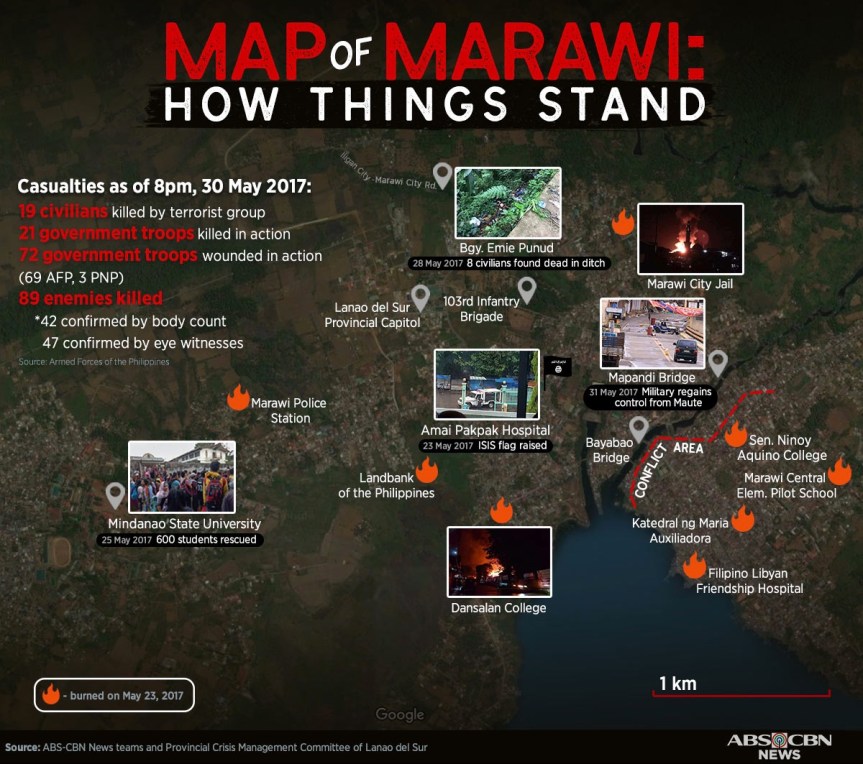
Continue reading “Conflict in Cities and the Contested Philippine State: Notes After Marawi” →


 Notes from the Field